The site generates orc-themed emails for you, which you can get emailed at (completely insecurely, it’s just a web address at mailinator to see the content). Please check out mailinator’s site, it’s a really neat project.
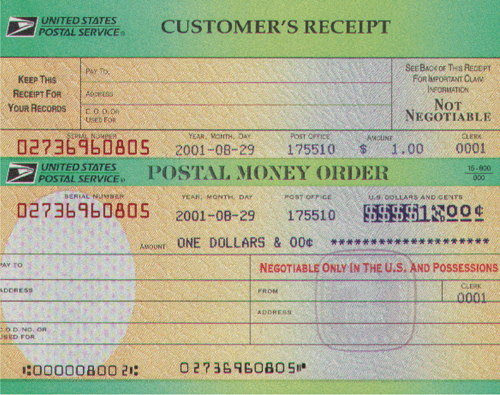
Allow me to introduce you all to the postal money order. For $1.50, you can get the equivalent of a cashier’s check from the post office. It can only be cashed by whoever you make it out to, and it’s basically accepted as cash by every corporation. You can also just give someone a blank one, although that’s riskier to carry around for the obvious reasons.
I was tired of checks bouncing. I can’t be bothered to make sure my account remains such-and-such, which means it happens sometimes, especially times like now when I’m poor. So I asked my landlord if I could pay by money order–he’d never heard of them before, but seemed okay with it when I explained (he’s a really good guy!).
I went down to the bank and got out $2750, and headed to the post office. I asked for 9 money orders, each for $303. The postal worker really only made a couple funny faces about me being weird, although my friend said she was pretty loud about my walking out with that much cash-equivalent, it went pretty well. And I immediately endorsed all the money orders so now they can lie around the hose safely.
Also, they come with attachable receipts (shown in the picture) in case you lose the check and need a replacement, so that’s nice.
Abbot: I will perform the opening prayer in the New Latin. Oh ordlay, ivethgay usway ouryay essingsblay. Amen-ay!
Read twitter in a one-per-line format without ever logging into the site
twitter_ebooks is a framework to make twitter bots, but it includes an ‘archive’ component to fetch historical account content which is apparently unique in that it 1) works with current TLS and 2) works the current twitter API. It stores the tweets in a JSON format which presumably matches the API return values. Usage is simple:
while read account
do
    ebooks archive "${account}" "archive/${account}.json"
    jq -r 'reverse | .\[\] | "\\(.created\_at|@sh)\\t \\(.text|@sh)"' "archive/${account}.json" >"archive/${account}.txt"
done
I ran into a bug with upstream incompatibilities which is easily fixed. Another caveat is that the twitter API only allows access 3200 tweets back in time for an account–all the more reason to set up archiving ASAP. Twitter’s rate-limiting is also extreme (15-180 req/15 min), and I’m worried about a problem where my naive script can’t make it through a list of more than 15 accounts even with no updates.
Edit: See here for an automatic version of the backup portion.
Connecting android to Windows and Mac, pretty easy. On arch linux? Major pain. Here’s what I did, mostly via the help of the arch wiki:
Rooted my phone. Otherwise you can’t back up major parts of the file system (including text messages and most application data) [EDIT: Actually, you can’t back these up over MTP even once you root your phone. Oops.]
Installed jmtpfs, a FUSE filesystem for mounting MTP, the new alternative to mount-as-storage on portable devices.
Enabled ‘user_allow_other’ in /etc/fuse.conf. I’m not sure if I needed to, but I did.
Plugged in the phone, and mounted the filesystem:
jmtpfs /media/android
The biggest pitfall I had was that if the phone’s screen is not unlocked at this point, mysterious failures will pop up later.
Synced the contents of the phone. For reasons I didn’t diagnose (I assume specific to FUSE), this actually fails as root: